
Timeline for an expert data project: a realistic week-by-week plan
For companies4 min read
A first expert data project usually takes longer to prepare than to run. The plan below is a template, not a promise: the weeks are examples you should adjust to your volume, your domain and how quickly your team can answer questions. The delays almost always come from guidelines and approvals, not labelling.
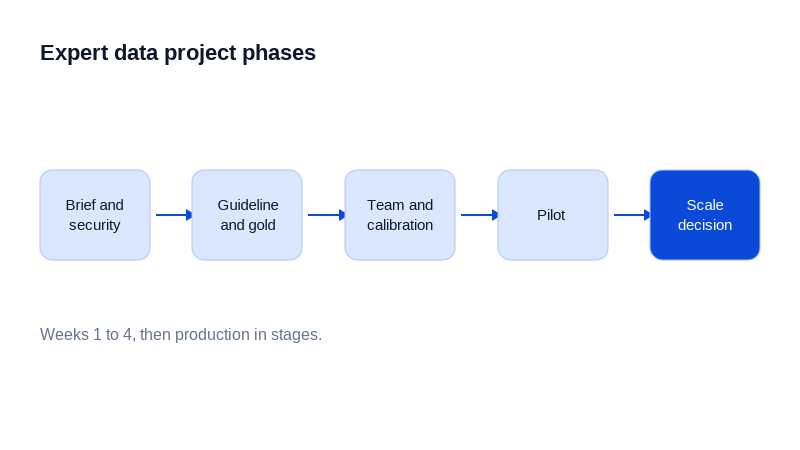
A template plan
| Weeks | Phase | Main output | Owner |
|---|---|---|---|
| 1 | Brief and security | Task definition, data classification, NDA and DPA signed | You and vendor |
| 1 to 2 | Guideline and gold set | Guideline v1, 20 to 50 gold items | Your model team with an expert |
| 2 to 3 | Team selection and calibration | Shortlist approved, calibration round done | Vendor and you |
| 3 to 4 | Pilot | 100 to 200 items, scored against pass mark | Vendor |
| 4 | Decision | Scale, fix and rerun, or stop | You |
| 5 onward | Production in stages | Weekly batches with review and metrics | Everyone |
Small text tasks can move faster. Rare domain skills, large volumes and strict security reviews take longer.
Week 1: brief and security
- Classify your data and decide what may leave your systems.
- Get the NDA and, where personal data is involved, the data processing agreement signed before real records are shared.
- Write the brief: model stage, domain, volume, format and quality target.
Security review is the most common source of surprise delays. Start it first, in parallel with everything else.
Weeks 1 to 2: guideline and gold set
This is your work, with an expert. Draft the guideline, label 20 to 50 gold items and run them past a second expert. Hand the draft to someone outside your team and watch where they stall. Plan for two revisions. Teams who skip this phase pay for it in the pilot.
Weeks 2 to 3: pick the team and calibrate
- Review the shortlist for skills, levels and confirmed resumes, and approve people.
- Share the guideline and give a day for questions.
- Run the calibration round: everyone labels the same 10 to 20 items.
- Discuss every disagreement, update the guideline, issue v1.1.
Weeks 3 to 4: pilot and decision
Run the pilot with hidden gold items and a double-annotated slice. Score it against the pass mark you wrote beforehand. Decide in a short meeting: scale, fix the guideline and run a smaller second round, or stop. Stopping after a pilot is a good outcome when the evidence says the task is not ready.
From week 5: production in stages
- Weekly batches with a fixed review rate.
- A weekly feedback call or written loop with the model team.
- Metrics each week: gold score, agreement, rework rate, time per item.
- A planned guideline update cycle.
What causes delays
| Cause | Fix |
|---|---|
| Guideline unclear | Pilot a draft with outsiders, answer questions in a day |
| Security review late | Start in week 1 |
| Slow answers from your team | Name one owner and a response time |
| Rare skill hard to find | Ask for the number of people with that skill level at the start |
| Changing scope | Version the brief and re-estimate when it changes |
| Data not ready | Prepare and clean 2x the pilot size before kickoff |
A note on estimates
Any vendor who promises an exact date before seeing your guideline and data is guessing. A better answer is a plan with phases, decision gates and dependencies on your side.
Compressing the plan
If you need results sooner, shorten the sequential parts, not the quality checks. Start the security review and guideline drafting together. Pre-approve a shortlist while the guideline is being written. Skip a long calibration only if the task is simple and the team has done similar work together. Do not skip the pilot. It is the part that protects the rest of the schedule.
Questions to ask your provider about time
- How many qualified people exist for this skill right now?
- How long from approval to first work?
- What is the review turnaround, and who is on the critical path?
- What happens to the schedule if the guideline changes in week 3?
Review points you should schedule
- End of week 2: guideline sign-off by both sides.
- End of week 3: team approved and calibrated.
- End of week 4: pilot decision.
- Every week after: a short review of quality numbers and open questions.
- Every month: a check of cost per accepted item against the plan.
Put these in calendars on day one. Reviews that are not scheduled tend to slide, and the project drifts without a decision.
On Curatrain, a project can start with a pilot, and the shortlist comes from experts who have already passed the tests your project needs, which shortens the team selection phase.