
How to run a paid pilot before a big data annotation project
For companies4 min read
A pilot is a small, paid batch of your real work, run before you commit to volume. It should answer three questions: can this team do the task, how much does a good item cost, and what breaks when you change the guidelines. Plan it like an experiment, with a pass mark set in advance.
Why pilot at all
Guidelines that read clearly to your model team often confuse the people who have to apply them. Edge cases you never imagined show up in the first hour. A pilot finds those problems while a mistake costs a few hundred items rather than tens of thousands.
It also gives you your real unit cost. A quote per task is a guess until you know how long a good item takes, how much gets reworked and how many items are thrown out.
Size it so the numbers mean something
Too small and one bad day decides the result. Too big and it is no longer a pilot. A workable range for most text tasks is 50 to 200 items, done by at least three people, with 10 to 20 percent of items given to two people independently so you can measure agreement. For rare, expensive expert tasks, use fewer items but keep the double coverage.
Pay for the pilot. Unpaid trials attract people who have time rather than skill, and they teach you nothing about real pricing.
Write the pass mark before you start
| Measure | How to get it | Example pass mark |
|---|---|---|
| Accuracy on gold items | Mix 10 to 15 items you have already solved into the batch | At least 90 percent on gold |
| Agreement between experts | Double-annotate a slice, compute kappa or alpha | Kappa of 0.6 or higher on the main label |
| Reason quality | Read 20 written reasons yourself | Most reasons cite the evidence in the item |
| Time per item | Log it from the platform, not from the vendor's claim | Within 25 percent of the quote |
| Rework rate | Share of items you send back | Under 15 percent |
| Questions raised | Count the useful questions about your guidelines | At least a handful in week one |
These marks are examples. Choose yours from what the model actually needs. If a wrong label costs you a bad model release, set the bar higher.
Run it in five steps
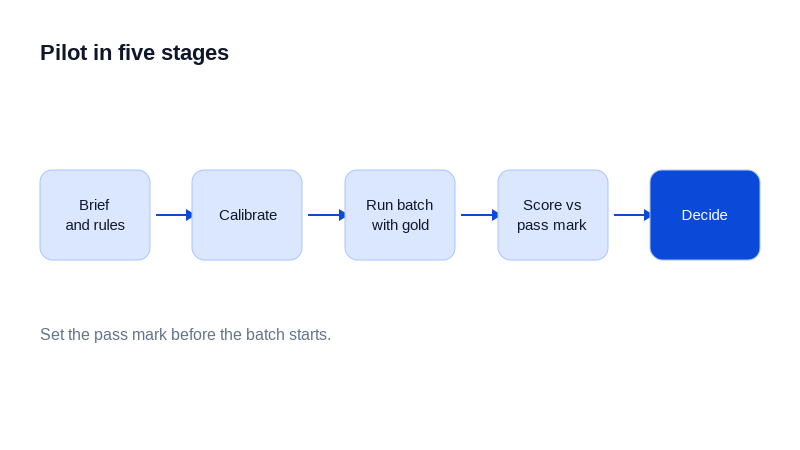
- Send the brief, guidelines and 10 sample items to the team and let them ask questions for a day.
- Run a calibration round: everyone labels the same 10 items, then you discuss every disagreement and update the guidelines.
- Release the main batch with gold items hidden inside it.
- Review a sample yourself. Do not outsource the whole review, because you are the only one who knows what the model needs.
- Score against the pass mark and write down what changed in the guidelines.
What to look at besides the score
- How quickly did the team find the holes in your guidelines? A team that asks good questions on day one will save you money later.
- Did quality hold across contributors, or did one person carry the batch? A pilot that passes because of one star will not scale.
- Were the written reasons specific, or the same sentence reworded?
- Did anyone flag a problem with your prompts or data, such as duplicates, leaked personal data or ambiguous questions?
Decide, then scale in steps
If the pilot passes, scale in stages: double the team and the volume, check the same measures, then double again. If it fails by a small margin, the usual cause is the guidelines, so fix them and rerun a short second round. If it fails because the people lack the skill for the task, no amount of guideline editing will fix it, and that is the most valuable thing a pilot can tell you.
What to hand over and what to keep back
Give the team the brief, the guideline, a sample of ten solved items and a channel for questions. Keep back the gold items and your scoring sheet. If the team sees the answers in advance, the pilot measures their memory, not their skill.
Choose pilot items that look like production, not the cleanest examples you have. A pilot on easy items passes, and then the full project fails on the messy ones. Include some items with missing context, unusual formatting and ambiguous wording, because that is what the real data holds.
A short pilot report
- What you asked for and the pass mark you set.
- The scores for each measure, next to the mark.
- Five examples of good work and five of poor work, with reasons.
- Changes made to the guideline during the pilot, with dates.
- The cost per accepted item and what you expect at volume.
- Your recommendation: scale, fix and rerun, or stop.
Write the report even if you are the only reader. In six months, when someone asks why you chose this team or this price, it will be the only record that explains the decision.
A project on Curatrain can start with a pilot, and the shortlist you see comes from experts who already passed the tests your project needs, so the pilot spends its time on your guidelines rather than on screening people.