Speech data collection for African languages: how to run it
For companies4 min read
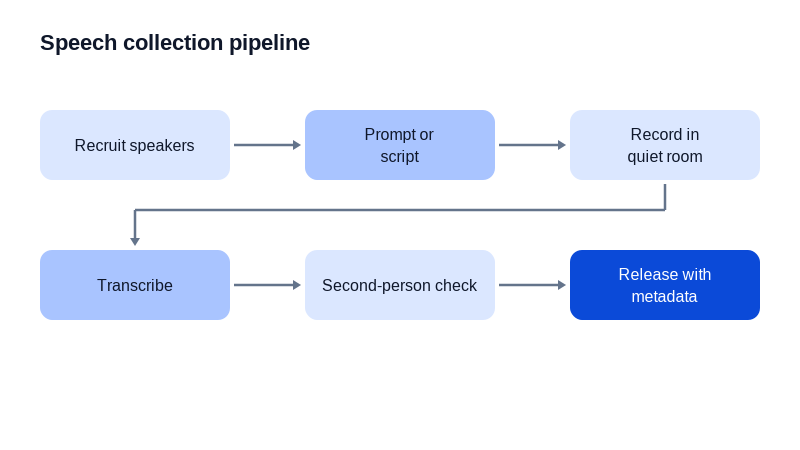
Speech data collection works when you decide who speaks, what prompts them, how each clip is checked and which tasks the audio must serve. Recording a few hundred hours is a logistics project as much as a technical one. Here is a plan built from what three public projects did.
What recent projects collected
Google Research's WAXAL covers 27 Sub-Saharan African languages spoken by over 100 million people across more than 26 countries. Its speech recognition portion holds about 1,846 hours of transcribed natural speech, and its text-to-speech portion over 565 hours of high-fidelity recordings. It is released under CC-BY-4.0 on Hugging Face.
Other reports give different language and hour counts for earlier and later versions of WAXAL, so check the dataset card for the release you plan to use.
A news report on African Next Voices says it holds about 9,000 hours of speech in 18 languages, recorded in Kenya, Nigeria and South Africa with a 2.2 million dollar grant from the Gates Foundation, and focused on everyday farming, health and education scenarios. That comes from a news article, not the project's own documentation, so confirm the figures before quoting them.
Prompting speakers: reading versus describing
WAXAL used two methods. For recognition data, participants described images drawn from Google's Open Images, covering 50 or more topics, in their own language, instead of reading scripts. For text to speech, community members worked in pairs and took turns as reader and recorder, using scripts of 10,000 to 20,000 words.
The difference is deliberate. Spontaneous description yields the hesitations, fillers and varied sentence shapes a voice assistant hears from real users. Read speech gives clean, consistent audio that text-to-speech voices need. Decide which one your product needs, because a project can be built on the wrong one by accident.
Volunteer or paid: the Common Voice model
Common Voice, described in its 2019 paper, relied on volunteers both to contribute recordings and to validate others. At the time it had about 2,500 hours of audio from over 50,000 participants across 29 languages in the latest release. Volunteer models scale but depend on a motivated community. If you need a language fast, with a defined schedule, paid and trained contributors give you control.
Source: Common Voice: A Massively-Multilingual Speech Corpus (arXiv:1912.06670)(opens in a new tab)
How much do you need
FLEURS, a speech benchmark covering 102 languages, offers about 12 hours of speech supervision per language. It is built for few-shot evaluation, not for training a production recogniser, but it tells you the scale at which research starts. Real products need far more, and the hours should come from many speakers.
Quality checks for speech data collection
- Speaker spread: balance age, gender, region and accent, and record them with consent.
- Environment: record in a quiet room and also in the noise your users face, if the product will run there.
- Transcription: have a native speaker transcribe, and a second person review a sample.
- Orthography: agree a spelling and numbers guide before transcription starts.
- Consent and privacy: explain use in the speaker's language and keep records of consent.
Tasks beyond transcription
Speech data supports more than recognition. With an expert reviewer you can label intent, check translations, rate the naturalness of a synthetic voice or flag content a voice assistant should not repeat. Plan for these early, because adding them later means re-listening to all the audio.
| Use | Data needed | Expert reviewer |
|---|---|---|
| Speech recognition | Natural speech with transcripts | Native speaker |
| Text to speech | Clean read speech with scripts | Native speaker and audio editor |
| Voice assistant | Commands and questions by intent | Native speaker with domain knowledge |
| Voice quality rating | Synthetic clips | Several native listeners |
Budget the time, not just the hours
One recorded hour needs recruiting, setup, listening, transcribing and checking. Teams that budget only for recording are surprised by the transcription and review load. Run a pilot of ten speakers first, time every stage and scale your plan from the measured figures.
Plan the consent process with the same care as the audio. Speakers should know in their own language what the recordings will be used for, who can hear them, how long they are kept and how to withdraw. Keep a signed or recorded consent for each speaker and tie it to the speaker identifier, not to a name in the file. Check the data protection law in each country where you record, using the regulator's own published guidance, since rules on voice data and on cross-border transfer differ.
Think about the field side too. Recording sessions go better with a local coordinator who speaks the language, a quiet room booked in advance, a short rehearsal and a break every half hour. Speakers tire, and the quality of the last twenty minutes of a long session is often lower than the first twenty. Log each session with date, place, device and coordinator, so a quality problem can be traced back to a cause.
Curatrain's experts include linguists who can transcribe, review and label language data, and companies get a shortlist from experts who passed the relevant tests, approving each match through a secure link. A project can begin with a pilot.