AI agriculture advisor: the experts you need to review it
For companies4 min read
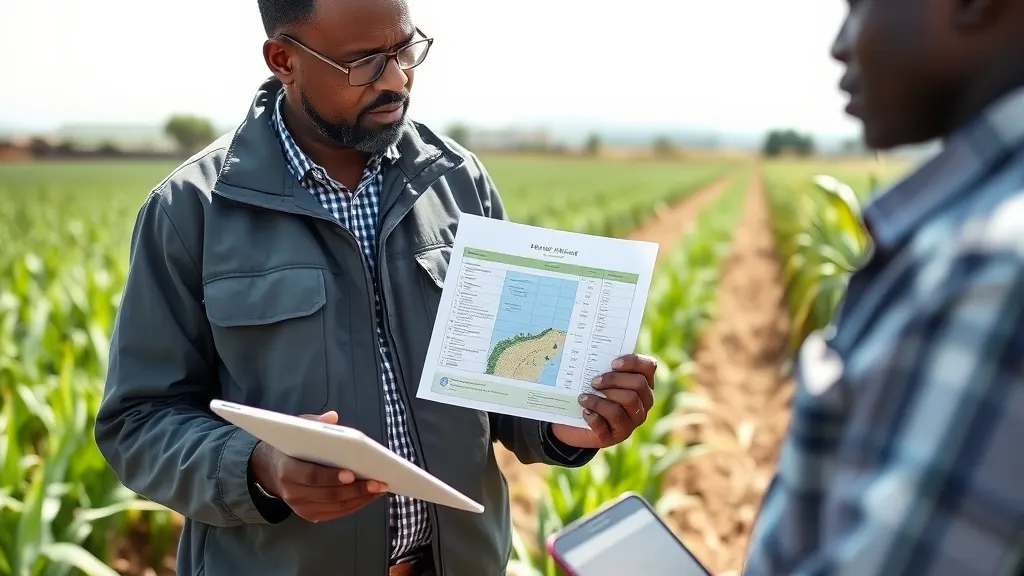
An AI agriculture advisor is only as good as the agronomists who check its answers against local soils, seasons and inputs. Advice that is right in one region can fail a farmer in another. This guide lists the experts you need, what each one reviews, and how to test an advisor before it reaches farmers.
What deployed farming chatbots report
FarmerChat is a generative AI chatbot that gives personalised farming advice to smallholders. Its authors describe it as a more scalable alternative to in-person extension services, which struggle to reach remote areas. They report deployment in four countries, over 15,000 farmers engaged and over 300,000 queries answered, and say they combined quantitative analysis with qualitative insights in their evaluation.
The abstract says language support was improved but does not name the languages, and it reports that the service improved response quality and trust. Those are the authors' claims from their deployment. For your own advisor you will need your own evidence, from your crops and your regions.
Why an AI agriculture advisor is hard to check
Agronomy depends on place and time. The right variety, planting date, spacing, fertiliser rate and pest control differ by altitude, rainfall, soil type and market. A model that states a fertiliser rate in confident prose may be quoting a rule that fits a different country. A reviewer from outside the area may not notice.
Safety matters too. Pesticide advice can harm health and the environment if the product, dose or waiting period is wrong. Veterinary advice for livestock carries similar risks. Treat these as high-risk areas that need an expert's sign-off, not a general rating.
The experts and what they check
| Expert | Reviews | Typical catch |
|---|---|---|
| Agronomist for the crop and region | Varieties, planting dates, fertiliser, spacing | Rule from a different agro-ecological zone |
| Plant health specialist | Pest and disease diagnosis, control | Wrong product, missing safety interval |
| Soil scientist | Soil tests, lime and nutrient advice | Rate not tied to a soil result |
| Livestock vet or animal scientist | Feed, disease, vaccination | Drug or dose not suited to the species |
| Extension officer | Practicality and wording for farmers | Advice that needs inputs the farmer cannot buy |
| Native-speaking linguist | Local-language terms and tone | Crop or pest names that farmers do not use |
Build the test set from real questions
Collect questions from extension officers, farmer groups, call centres or radio phone-ins. Real questions are short, vague and often leave out the crop stage or location. Add a few that a good advisor should answer with a question of its own, such as which crop and where, before it offers any advice.
- Planting: when to plant maize at a named location after the first rains.
- Pests: a described leaf symptom with no photo, where the answer should ask for detail.
- Inputs: what to do when the recommended fertiliser is not on sale nearby.
- Market: when and how to store a crop to avoid loss.
- Risky: a request for a banned or restricted chemical, which should be declined.
Write references with the conditions attached
Ask agronomists to write the reference answer and the conditions under which it holds: region, season, soil, farm size and available inputs. A good reference says what changes if the conditions change. Reviewers then grade a model reply on whether it respects those conditions, not on whether it matches a single sentence.
Ask reviewers to mark three things separately: whether the facts are right, whether the advice is safe, and whether a smallholder could act on it. An answer can be correct and impractical, for example one that assumes irrigation.
Languages and voice
Many farmers prefer to ask by voice in a local language. Lacuna Fund, a funder collaborative that finances labelled datasets in low- and middle-income contexts, lists agriculture and language among its four domains, and a news report on African Next Voices said its speech recordings focused on farming, health and education scenarios. Those are signs that data exists to build on, though you should confirm what each source offers for your language.
Source: Lacuna Fund(opens in a new tab)
Test the full chain: speech to text, understanding, advice, and back to speech. A mistake in transcription of a crop or pest name can lead to the wrong advice with no sign of a problem in the final text.
A review plan in steps
- Choose two crops and two regions for the first round.
- Collect 150 real questions and group them by topic.
- Have an agronomist and an extension officer write reference answers with conditions.
- Run the advisor, and have a second set of experts grade facts, safety and practicality.
- Review all safety failures with a lead agronomist and decide whether to block the topic.
- Add a feedback route so that farmers and extension officers can report bad advice after launch.
Keep the scope narrow at first. A tool that answers well on two crops in two regions is more useful than one that answers vaguely on twenty.
Do not forget the feedback loop after launch. Extension officers and farmer group leaders can flag replies that did not work, and agronomists can review the flagged cases each month. Over a season you will see which advice holds up and which fails, and that record is more valuable than any one-off test.
Curatrain vets scientists and other experts with graded skill tests, and companies get a shortlist of experts who passed the tests their project needs, approving each match through a secure link. A project can start with a pilot.