
Agent control plane open source: what AgentOven is and where it stands
For agent builders4 min read

AgentOven is an agent control plane open source project: a service that registers, deploys, routes and watches agents built with different frameworks. This post reads the project's own pages to say what it does and what is still unproven. It is an alpha project, so treat every feature below as something to test, not something to rely on.
What an agent control plane is
Once you have more than one agent, new questions appear. Which agents exist and which version is live? Which model does each one call? What did last week's runs cost? A control plane answers those in one place, outside the code of any single agent.
AgentOven describes itself as an open source, framework agnostic agent control plane with built-in support for the A2A and MCP protocols. Its homepage says it covers three jobs: governing agents, connecting them, and testing them before release.
Source: AgentOven homepage(opens in a new tab)
Source: AgentOven on GitHub(opens in a new tab)
How the pieces fit
The architecture page lists four layers that can be deployed separately. A Rust command line tool and SDKs for Python, TypeScript and Rust. A control plane written in Go that holds the agent registry, the recipe workflow engine, the task router and authentication. A protocol layer for A2A and MCP. And the infrastructure underneath: PostgreSQL for state, Redis for caching and messaging, and an OpenTelemetry Collector.
The GitHub README adds one detail: a Rust runtime executes the agents, instruments them, routes calls and enforces policies, while agents written with LangGraph, CrewAI, the OpenAI SDK, AutoGen or custom code run on top.
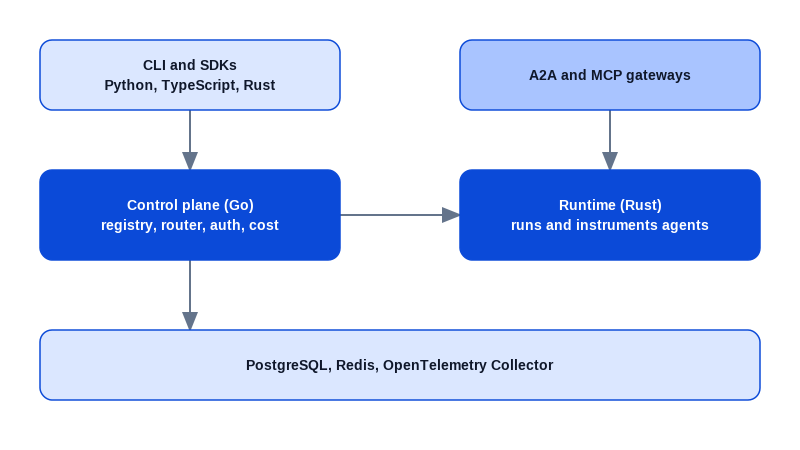
Source: AgentOven architecture docs(opens in a new tab)
Agent control plane open source: what it says it can do
| Area | What the pages describe |
|---|---|
| Registry | Register, version and list agents; a catalog it calls the Menu |
| Lifecycle | Bake (deploy), cool (pause), rewarm (resume), recook (hot swap), retire |
| Model router | Several providers with fallback, plus cost, latency, round robin and A/B strategies |
| Protocols | Each baked agent gets an A2A endpoint; tools are reached through an MCP gateway |
| Observability | OpenTelemetry spans for each step, plus cost per agent and per kitchen |
| Workflows | Recipes: DAGs of agents with parallel steps and human approval gates |
| Memory and RAG | A three layer memory system called the Pantry, and retrieval pipelines |
| Guardrails | Checks such as PII detection and prompt injection, with workspace defaults |
Source: Why AgentOven (docs)(opens in a new tab)
The kitchen vocabulary is easy to learn. The oven is the control plane. A kitchen is a workspace that isolates agents, configs and secrets, and the docs compare it to a Kubernetes namespace for agents. An ingredient is a model, tool, prompt or data source an agent needs. A recipe is a workflow.
Source: Kitchen vocabulary (docs)(opens in a new tab)
Where the project stands
PyPI lists the Python package at version 0.9.0, uploaded on 9 October 2026, with the classifier Development Status 3, Alpha. The version history starts in February 2026, so the project is under a year old at the time of writing.
Source: agentoven on PyPI(opens in a new tab)
Several features carry an early label on the project's own pages. Simulated worlds and RL environments for testing agents are called early access. LLM judge scoring is on the roadmap. Some governance features, such as SSO and a longer trace retention window, appear in the README's table of paid enterprise features, and the Python package has a Pro realtime voice section.
The pages also disagree in small ways. The PyPI metadata says Apache-2.0 while the package README says MIT. The docs ask for Python 3.10, PyPI says 3.9 or newer. The Python examples differ between the homepage, the docs and PyPI. None of this is unusual for an alpha, but it means you should read the version you install.
It is also an open core project. The README's table splits features into an Apache licensed open source edition and an enterprise edition. Single tenant registry, the full A2A and MCP protocols, routing with fallback and self hosting are in the open source column. Multi tenant registries, SSO, longer retention and a managed cloud are in the enterprise column. Before you plan around a feature, check which column it is in.
Should you try it?
Try it if you run, or plan to run, agents from more than one framework and want a single registry, one trace format and one place to see cost. Try it in a scratch environment first. The pages show no benchmarks and no production case studies, and neither does this post.
Skip it if you have one agent in one framework. The tracing and tooling you already have will do more for less setup.
The next posts in this series show a first run, mixed frameworks under one control plane, and the tracing and cost features. If you test agents you build, Curatrain's experts write realistic tasks, tools and checkers for AI agents, which is the same idea as the early access RL environments above.