
What is an RL environment in AI? A plain explanation for agent builders
For agent builders4 min read
People who ask what is an RL environment in AI usually get a definition with no example. The short answer: it is a small world an agent can act in, with a way to start it fresh, a way to apply the agent's actions, and a score at the end. In classic reinforcement learning the world is a game or a simulator. For an LLM agent it is a task, a set of tools and a checker that decides whether the task was done.
What is an RL environment in AI? The loop every one shares
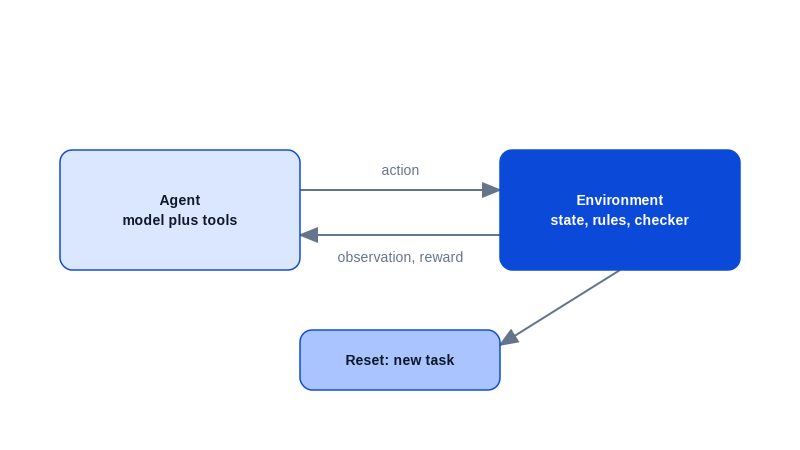
Gymnasium defines the vocabulary most people use for this. An environment has a reset call that starts a new episode and returns an observation. It has a step call that takes one action and returns five things: the new observation, a reward, a terminated flag, a truncated flag and an info dictionary.
The two flags differ. Terminated means the task itself ended, by succeeding or failing. Truncated means something outside the task stopped it, such as a step limit. The agent observes, acts, gets a new observation and a reward, and repeats until one flag is true. Then the environment is reset.
Source: Gymnasium: basic usage(opens in a new tab)
What changes when the agent is an LLM
An LLM agent does not move left or right. Its actions are tool calls: run a shell command, read a file, query an API, click a button. The observation is the tool's output. The episode is one attempt at a task, and it ends when the agent says it is done or runs out of steps.
The part that is easy to underrate is the reward. In a game the score is built in. For an agent task somebody has to write the checker, and its quality sets the ceiling on everything trained or measured with it.
The five parts of an agent environment
| Part | What it is | Example for a file task |
|---|---|---|
| Task | The instruction the agent receives | Rename the draft report to final |
| Tools | The actions the agent may take | List files, read a file, move a file |
| State | What the world holds and what tools change | A small in-memory file system |
| Checker | Code that scores the end state | Does the final file exist with the same contents? |
| Reset | A way to start clean, often with a seed | Create the same files, with random contents |
Each part can fail on its own. Vague tasks produce arguments about the right answer. Missing tools make the task impossible. State that survives from one attempt to the next gives one run an unfair advantage. A checker that looks only at the agent's last message is not checking the world at all.
Grade the outcome, not just the words
Anthropic's guide to agent evaluations draws the line well. The outcome is the final state of the environment, such as whether a booking exists in the database, not just whether the agent said it made one. The same guide recommends grading what was produced rather than the exact path taken, because agents often find valid routes the designer did not expect.
Source: Demystifying evals for AI agents(opens in a new tab)
What a weak environment looks like
A weak environment is easy to spot once you know the signs. The task can be passed without the work, for example by printing the words the checker looks for. The tools allow actions that should be impossible, such as editing the answer key. Or the reset leaves leftovers from the last episode, so success depends on run order. When you see any of these, fix the environment before you draw conclusions from its scores.
Where environments get used
- Evaluation: run an agent through many tasks and report how often the checker passes.
- Training: use the checker's score as a reward signal for reinforcement learning.
- Debugging: replay one failing task and read the steps.
The same environment can serve all three, which is why the checker deserves care. A loose check that is tolerable for a quick evaluation becomes a problem when a model is optimized against it. The post on reward hacking covers that.
A good first environment
Start with a task you can state in two sentences, a handful of tools, a state you can reset in one call, and a checker of under thirty lines. Run a scripted solution through it to prove the task can be solved, then run a deliberately wrong one to prove the checker can fail. Gymnasium's own guide for custom environments follows the same shape: define the spaces, write reset, write step, and give episodes a step limit.
Source: Gymnasium: create a custom environment(opens in a new tab)
Curatrain's experts also write realistic tasks, tools and checkers for AI agents, which is this work done by people who know the domain. The next post builds one in Python.