
RLVR vs RLHF: the difference and what it means for your work
For experts4 min read
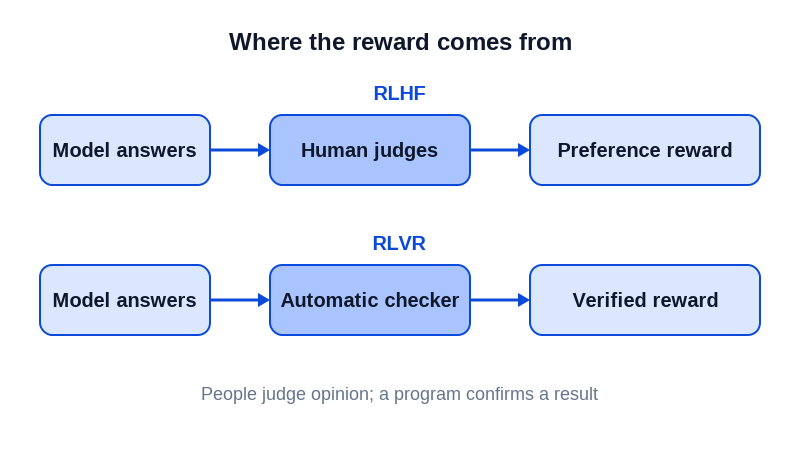
RLVR vs RLHF comes down to who or what gives the reward. In RLHF, people judge answers. In RLVR, a program checks the final result. The difference decides what kind of work experts are asked to do.
RLVR vs RLHF in one sentence each
RLHF means reinforcement learning from human feedback. Humans compare answers, and a reward model learns those preferences. The model is then trained to produce answers that score well with that reward model.
RLVR means reinforcement learning with verifiable rewards. The reward comes from a check that can be run automatically, such as whether a number matches the known answer or whether code passes its tests. The name was given to a training method in the Tulu 3 paper, where it was used alongside supervised fine-tuning and preference tuning.
Source: Tulu 3: Pushing Frontiers in Open Language Model Post-Training(opens in a new tab)
A side by side comparison
| RLHF | RLVR | |
|---|---|---|
| Where the reward comes from | People rank or score answers | A program checks the result |
| Best for | Style, helpfulness, safety, tone | Maths, code, logic, data extraction, anything with a right answer |
| Your main task | Compare answers and give reasons | Write problems with one checkable answer |
| Main risk | Reward goes to answers people like, not answers that are true | A weak checker can be fooled or can reject correct answers |
| Cost per item | A person reads every item | A person writes the problem once, a program scores it many times |
Why RLVR needs different expert work
A preference judgement is a matter of opinion, so RLHF needs many readers and a clear guideline. A verifiable reward needs the opposite: one answer that a program can confirm without opinion. The expert's job moves from reading answers to designing questions.
A good verifiable problem has a final answer in a fixed form, such as an integer, a string, or a list. It has no second valid answer the checker would reject. It can be solved by reasoning, not by guessing. It also has a reference solution that you can defend.
What each approach cannot do
- RLHF cannot confirm facts. A confident wrong answer can win a comparison if the rater did not check it.
- RLVR cannot score style or kindness. A reply can be correct and still be rude or confusing.
- RLVR only covers tasks with a clear answer. Writing advice, medical triage talk and ethics questions do not fit.
- Both can be gamed. A model may learn to find the pattern the reward likes instead of the skill you wanted.
This is why labs use both. Verifiable rewards build reasoning on tasks with a right answer, and human preference data shapes tone and safety. Neither replaces the other.
Example: the same topic two ways
Take a topic such as loan interest. An RLHF task shows two explanations of compound interest for a new borrower and asks which is clearer and safer. An RLVR task asks: A loan of 1,000 dollars grows at 5 percent a year, compounded annually. What is the balance after 3 years, rounded to the nearest cent? The answer, 1157.63, is a single string a program can match.
The first task needs your judgement of the reader. The second needs your arithmetic and your care in stating rounding and units, so that a correct solver does not get marked wrong.
How to prepare for either
- For RLHF: practise reading two answers against a prompt and writing a one-sentence reason that cites a fact or an instruction.
- For RLVR: practise writing questions from your field with a single numeric or short-text answer, and solve them again yourself a day later.
- For both: check facts, state assumptions, and keep a short note of why your answer is right.
People with training in maths, science, programming, finance and engineering are well placed for RLVR work, because they can tell when a problem has two valid answers. People with strength in language, medicine, law and teaching are well placed for judging tone and safety.
A note on reward hacking
Any reward can be exploited. In RLVR, a model that is rewarded only for matching a final answer may learn shortcuts, such as guessing common values or copying a number from the prompt. Experts reduce this by writing problems where the answer cannot be guessed and where the working matters. When a project also asks for written reasoning, graders can check that the steps lead to the answer.
In RLHF the equivalent problem is rewarding the look of quality. A longer, more confident answer may be preferred even if it is thinner on facts. Rater guidelines exist to push against this, and your written reasons are one of the ways teams find out when it happens.
Curatrain's experts do both kinds of work: preference ranking and problems that a program can check. You take graded tests for each skill and see your score when you finish.