
Math reasoning dataset design: step-by-step checking by experts
For companies4 min read
A good math reasoning dataset records the working, not just the answer. The strongest public example, PRM800K, holds 800,000 step-level labels from human reviewers. This post explains what the main math datasets contain, why step checking matters, and how to organise mathematicians to label steps.
Three datasets to know before you build a math reasoning dataset
GSM8K introduced 8.5K grade school math word problems described as high-quality and linguistically diverse. The authors trained verifiers, models that judge whether a completion is correct, and found that verification significantly improved performance. They reported that verification scales more effectively with increased data than a fine-tuning baseline.
Source: Training Verifiers to Solve Math Word Problems (arXiv:2110.14168)(opens in a new tab)
The MATH dataset has 12,500 competition mathematics problems, and each comes with a full step-by-step solution. The authors wrote that accuracy remains relatively low even for very large models, and that scaling is not currently solving MATH.
Source: Measuring Mathematical Problem Solving With the MATH Dataset (arXiv:2103.03874)(opens in a new tab)
PRM800K came from a paper titled Let's Verify Step by Step. It compares outcome supervision, which gives feedback on only the final result, with process supervision, which gives feedback on each intermediate step. The authors found that process supervision clearly beat outcome supervision on the MATH dataset, with the process-supervised model solving 78% of problems from a representative subset of the test set.
Source: Let's Verify Step by Step (arXiv:2305.20050)(opens in a new tab)
Why step labels beat final-answer checks
A model can reach the right number through broken reasoning, for example by cancelling terms that should not cancel and then making a second mistake that fixes the result. Final-answer checking rewards it. Step labels do not. They also tell the trainer where the reasoning went wrong, which is far more useful than a single wrong mark.
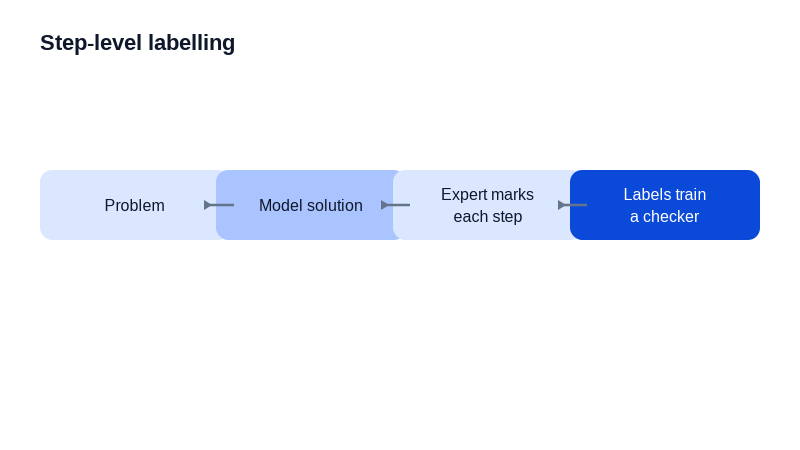
Design the labelling task
Decide the label scale before the first solution is shown. PRM800K-style work asks reviewers to judge each step; a simple scale is correct, neutral or incorrect. Add a free-text box for the reason when a step is wrong. A short reason, such as sign error in line three, is useful for training and for auditing the reviewer.
- Correct: the step follows from the earlier ones and moves toward the answer.
- Neutral: true but unhelpful, such as restating the question.
- Incorrect: a calculation error, a false claim or an unjustified jump.
- First error rule: after the first incorrect step, later steps are judged on their own logic or skipped, whichever your guideline says.
Write that last rule down and apply it everywhere. Without it, reviewers handle later steps in different ways and your labels are inconsistent.
Choose reviewers by level
A grade school word problem can be checked by a teacher or a strong undergraduate. Competition problems need people who have solved similar ones. Proof-based material needs a mathematician who can tell a gap from a standard step. Match difficulty to reviewer, and test reviewers on a small gold set where the right labels are known.
| Content | Reviewer | Check |
|---|---|---|
| Grade school word problems | Teacher or maths graduate | Arithmetic, setup, units |
| Competition problems | Competition-experienced solver | Method, case coverage |
| University topics | Maths or physics graduate | Definitions, theorem conditions |
| Proofs | Postgraduate mathematician | Gaps, circular arguments |
Make answers machine-checkable where you can
Problems with a single final answer, such as an integer or a closed-form expression, can be checked by a program, which makes large-scale training cheaper. Ask experts to write each problem with a precisely specified answer format, and to rewrite any that have more than one valid form. Keep the expert step labels for the cases where a program cannot judge the reasoning. A useful split is to let the program check final answers on the whole set and to send only a sample, plus every case where the program and the model disagree with the reference, to a mathematician for step review. This keeps expert hours for the problems where they change the data most. Also keep the units and rounding rules in the problem text, since many wrong marks come from a correct answer written in a different form.
Write a short style guide for solutions as well. Decide whether steps should be one line each, whether a skipped algebra move counts as a gap and how much explanation a step needs. Reviewers apply labels more evenly when the steps they judge are all written in the same way.
Quality control that works
- Seed 5 to 10 percent of tasks with solutions whose labels are already known.
- Have two reviewers label a shared slice and compare their step labels.
- Review each disagreement with a senior mathematician and update the guideline.
- Track reviewers who label too many steps correct, which is the common failure.
- Hold back a final test set labelled only by your best reviewers.
Curatrain vets maths specialists with graded skill tests, and its experts do work such as problems a program can check and reference answers with rubrics. Companies get a shortlist of experts who passed the tests the project needs, with confirmed resumes.