
LLM as a judge evaluation: where expert review still has to stay
For companies4 min read
LLM as a judge evaluation uses one model to score another model's answers. It is fast and cheap, and for general chat it tracks human preferences well. For specialist fields it needs checking against experts, because its known biases and blind spots do not go away. This post shows how to calibrate a judge and where to keep humans.
LLM as a judge evaluation: what the original study found
The MT-Bench and Chatbot Arena paper tested strong models, such as GPT-4, as judges. The authors report that these judges can match controlled and crowdsourced human preferences, achieving over 80% agreement, which they say is the same level of agreement humans reach with each other. They released the MT-bench questions, 3K expert votes and 30K conversations with human preferences.
Source: Judging LLM-as-a-Judge with MT-Bench and Chatbot Arena (arXiv:2306.05685)(opens in a new tab)
The same paper lists the biases and limits of a model judge: position bias, verbosity bias, self-enhancement bias and limited reasoning ability. The authors propose ways to reduce some of these.
What each bias does to your results
| Bias | What happens | Test for it |
|---|---|---|
| Position | The judge favours the first or second answer | Swap the order and see if the verdict flips |
| Verbosity | Longer answers score higher | Pad a good answer and see if its score rises |
| Self-enhancement | A model rates its own style higher | Compare scores for the judge's own outputs and others |
| Limited reasoning | It misses errors in maths or logic | Plant wrong answers with confident wording |
These tests are cheap, and you can run them on any judge before you rely on it.
Where the 80% figure stops applying
The study measured agreement on general chat questions, with raters who were not necessarily specialists. A medical, legal or financial answer has errors that a non-specialist, human or model, may not see. The earlier GPQA study found that skilled non-experts with web access reached 34% on graduate science questions, against 65% for experts, so agreement between a non-expert and a model proves little about expert-level correctness.
Source: GPQA: A Graduate-Level Google-Proof Q&A Benchmark (arXiv:2311.12022)(opens in a new tab)
In short, the judge is a stand-in for the rater you gave it. If your gold ratings come from experts, you can measure how far the judge strays from them. If you have none, you do not know.
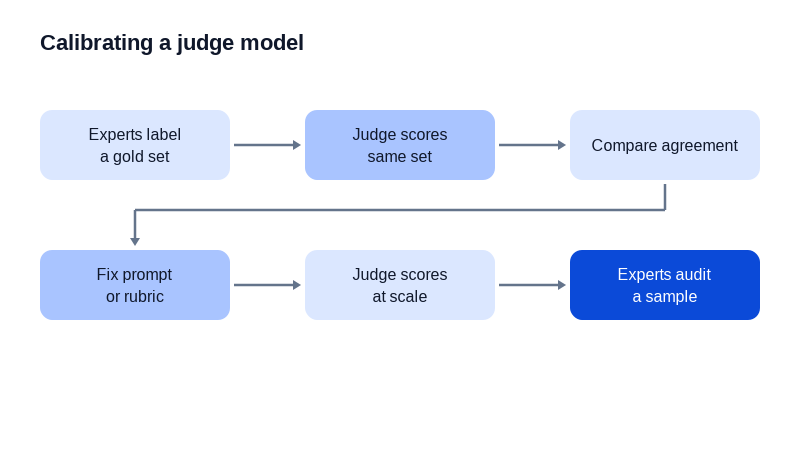
Calibrate the judge in steps
- Have domain experts rate 100 to 300 answers with a written rubric. This is your gold set.
- Run the judge on the same answers using the same rubric text.
- Measure agreement with the experts, per rubric line and per topic, using an agreement statistic.
- Read the cases where they differ. Fix the rubric wording, add examples to the judge prompt or restrict the judge to lines it handles well.
- Run the bias tests above: swap order, pad length, plant errors.
- Use the judge at scale only on the lines where it agrees with experts, and keep experts on the rest.
A sensible division of labour
- Judge model: format checks, instruction following, language fluency, regressions between versions.
- Generalist human: tone, readability, obvious refusals.
- Domain expert: factual correctness, safety, completeness, jurisdiction or local fit.
- Expert audit: a random sample of judge decisions every week, to catch drift.
Keep the judge from grading itself
Use a different model as judge from the one you are evaluating when you can, and say which judge you used. If you tune your product to please the judge, scores will rise while real quality stays flat. Keep a human-rated holdout set that the judge never sees during tuning, and compare.
Pairwise or single-answer scoring
Pairwise comparison, where the judge picks the better of two answers, tends to be easier for models and people than assigning absolute scores. Single-answer scoring is useful for pass or fail checks against a rubric. Use pairwise for choosing between versions and rubric scoring for diagnosis. In both cases, randomise the order. Log the judge's written reason with each verdict, since a reason that contradicts the verdict is a quick way to find a broken prompt.
What to report
State the judge model, the prompt, the rubric, the gold set size, the agreement with experts and the biases you tested. Say which parts of the evaluation were done by experts and how many. A buyer reading your report will trust a mix of cheap automatic scoring and visible expert checks more than either alone.
Re-check the judge whenever you change its model or prompt, because a small wording change can shift scores more than a model upgrade does. Keep the gold set fixed so results stay comparable over time.
Curatrain vets experts including doctors, lawyers, engineers and finance specialists with graded skill tests, and its experts write reference answers with rubrics and rank outputs. Companies approve each shortlisted match through a secure link, and a pilot can build your first gold set.