
Building a feedback loop between your model team and annotators
For companies4 min read

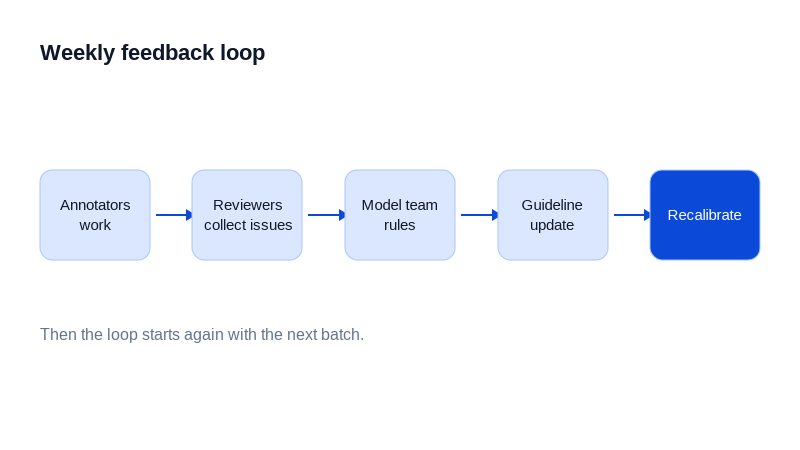
Annotators see things your model team never does: ambiguous prompts, broken items and patterns in the model's mistakes. A weekly loop that carries their questions to the model team and the model team's findings back to them is the cheapest quality upgrade available.
Why the usual setup fails
In most projects, the model team writes a guideline, hands it over and waits for data. Questions go through a project manager and arrive days late. When the model misbehaves, nobody tells the people who wrote the training data. The loop is open, so errors repeat for weeks.
The weekly rhythm
| Day | Who | What |
|---|---|---|
| Monday | Reviewers | Send the list of disagreements and unclear items from last week |
| Tuesday | Model team | Answer each with a ruling and a reason |
| Wednesday | Project lead | Update the guideline, bump the version, note which items to redo |
| Thursday | Model team | Share three failure examples from the latest model |
| Friday | Annotators | Calibration round on 10 items touching the new rules |
The days are an example. What matters is a fixed cycle with a named owner for each step.
What annotators should send up
- Items they could not answer and why.
- Pairs of items that look the same but need different labels.
- Patterns they keep seeing in the model's output.
- Rules that conflict with each other.
- Places where following the guideline gives an answer they believe is wrong.
Give them a short, structured way to do it, so a note takes under a minute. If it takes ten minutes to raise a question, they will guess.
What the model team should send down
- Show real failures of the model, with the prompt and output, and explain what the data should teach.
- Say which categories the next batch should focus on and why.
- Publish the quality numbers: gold score, agreement, rework rate, per batch.
- Close the loop on past questions, so people see their notes changed something.
Keep a decision log
2026-10-14 Q: Is a polite refusal with a source link a good answer? A: No. Refusals need a reason, links are optional. Guideline v1.4, rule 7. Redo items 120-188.A log of rulings removes repeat arguments, and new joiners can read it in an hour. It also shows which parts of the guideline keep drawing questions.
Read the written reasons
Annotators' reasons are the cheapest diagnostic you have. When a reason contradicts the label, the person did not understand the rule. When ten reasons use the same incorrect rule, the guideline taught it. Sample reasons every week.
Avoid these loops
- Only the project manager talks to the model team. Information gets filtered.
- Updates arrive without telling people which items to redo.
- Blame: showing the model team's failures as annotator errors.
- Too many meetings. A short written loop beats a long call.
Measure the loop
- Time from question to ruling.
- Number of repeated questions per week; it should fall.
- Agreement and gold score after each guideline version.
- Rework rate by batch.
Roles
- Loop owner: usually a project lead on the vendor or annotation side. Runs the cycle and keeps the log.
- Model team contact: one named person who answers within a day.
- Reviewers: collect issues from annotators and filter duplicates.
- Guideline editor: one person who changes the document, so versions stay clean.
A named owner for each role removes the most common failure, in which everybody assumes someone else is passing the question on.
A quarterly step back
Every quarter, read the decision log from top to bottom. Group the rulings by topic. If one topic has twenty rulings, it deserves its own section in the guideline, or the task needs redefining. Share the grouped log with the model team: it is a clear picture of where your task definition was weakest.
A starter template for questions
Give annotators a form with four short fields: the item id, what the guideline says, what they were unsure about, and what they chose. Four fields take under a minute to fill and give the model team everything needed to rule. Free-form messages are slower to write and slower to answer, and the missing item id is the usual reason a question sits unanswered for days.
Review the form's use every week. A drop in questions is not always good news: it may mean people have stopped asking.
On Curatrain, experts give written reasons with their labels, which gives your team material to read and feed back into the guideline.