Clinical AI validation: a step-by-step plan for expert review
For companies4 min read

Clinical AI validation is the work of showing, with clinicians who are not on your payroll's product team, that a model behaves safely on the cases it will meet. It is a process with a scope, a rater panel, a record of disagreements and a written result. Here is a plan you can run before a pilot with a hospital or health programme.
Clinical AI validation starts with the intended use
Validation fails most often because nobody wrote down the intended use. A symptom checker that suggests a care level, a summariser that drafts discharge notes and a tool that answers pharmacists' questions are three different products with three different risks. Write one paragraph for each: who uses it, what it may output, what it must never do, and what a human still checks.
Everything else in the plan follows from that paragraph. It decides which clinicians you need, what a bad answer looks like and how many cases are enough. It also tells you what to leave out. If the tool never gives dosing advice, you do not need a pharmacology panel, and you can say so in the report instead of pretending to cover it. Share the paragraph with the hospital or programme you are working with, and ask a clinical lead there to sign it off before any rating begins.
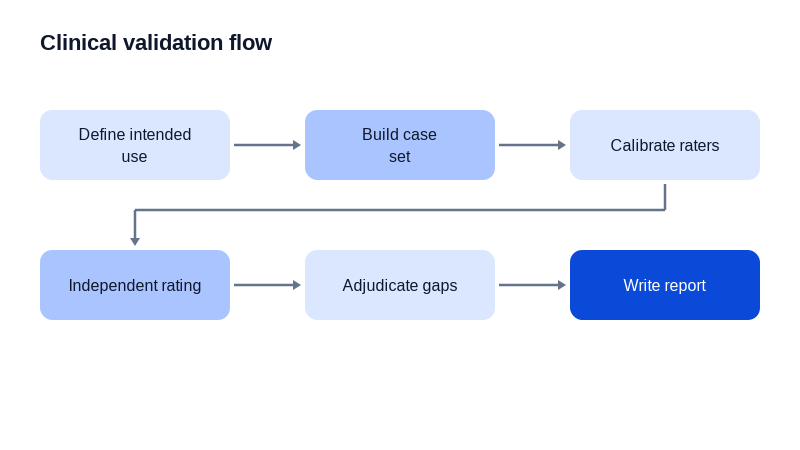
Stage one: build a case set that looks like practice
Take cases from the real setting, with identifying details removed under your data agreement. Include the ordinary ones, because most of a clinic's day is ordinary, and a set of only exotic cases will not tell you how often the model errs on routine ones. Add a set of rare but dangerous cases on purpose, such as a chest pain message with no mention of pain in the first line.
Published work shows how much human judgement matters here. When the Med-PaLM authors built their evaluation, they did not rely on answer keys alone. They had raters judge factuality, precision, possible harm and bias.
Source: Large Language Models Encode Clinical Knowledge (arXiv:2212.13138)(opens in a new tab)
Stage two: calibrate your raters
Before the real round, give every rater the same ten cases and compare their scores in a short call. This is where you find that one nurse treats any missing allergy question as a failure while a consultant ignores it. Agree on the rules, rewrite the rubric where it was vague, and only then start.
Record each rater's specialty, years in practice and country of training. A rater trained in one health system may judge a drug choice or a referral route differently from someone who works in another. If the product will run in Kenya, at least some of your raters should work under Kenyan guidelines.
Stage three: rate independently, then adjudicate
Each case should be scored by two clinicians who cannot see each other's marks. Where they agree, accept the score. Where they differ by more than a set margin, or one flags possible harm and the other does not, send the case to a third, more senior reviewer.
- Keep the model's full output, not a cleaned-up version.
- Require a written reason for every harm flag.
- Keep rater identity in your records but hide it from other raters.
- Log every rubric change with a date, so earlier scores can be re-read.
Do not discard adjudicated disagreements as noise. They are your best evidence of where the model's behaviour is unclear, and they often become the next round's test cases.
Stage four: report in a way a clinical lead will trust
A one-line accuracy number will not satisfy a medical director. Report results by case type and by severity, show the harm-flagged cases in full, and say how many raters scored each item and how often they agreed. State plainly what the validation did not cover, such as languages, age groups or specialties outside the case set.
The Med-PaLM 2 paper gives a sense of the format that readers expect. It describes physicians ranking answers in pairwise comparisons of 1,066 consumer medical questions, and a separate set of 240 long-form adversarial questions for stress testing. The two sets answer different questions, and the report treats them separately.
What validation does not replace
A validation round tells you how the model behaved on your cases at one time. It does not replace regulatory review, a clinical trial where one is required, or monitoring after launch. Check the rules that apply in each country where you will deploy, using the regulator's own published guidance.
Re-run a smaller version of the same case set whenever you change the model, the prompt or the retrieval source. A fixed set of cases with fixed rubrics lets you see regressions quickly.
Curatrain's clinical experts are vetted with graded skill tests taken on camera, and companies approve each match on a shortlist through a secure link. If you want to try a panel on a small case set first, a project can start with a pilot.