
AI code evaluator job: how coding tests are graded
For experts4 min read

An AI code evaluator job usually starts with a coding test that checks whether you can write correct code and judge other people's code. Tests differ between projects, but most mix automatic checks with a read of your written reasons.
How the test behind an AI code evaluator job is usually graded
This post describes the common ways coding assessments are graded in general. It is not a description of any one company's marking, and a test you take will give its own instructions. Read those first.
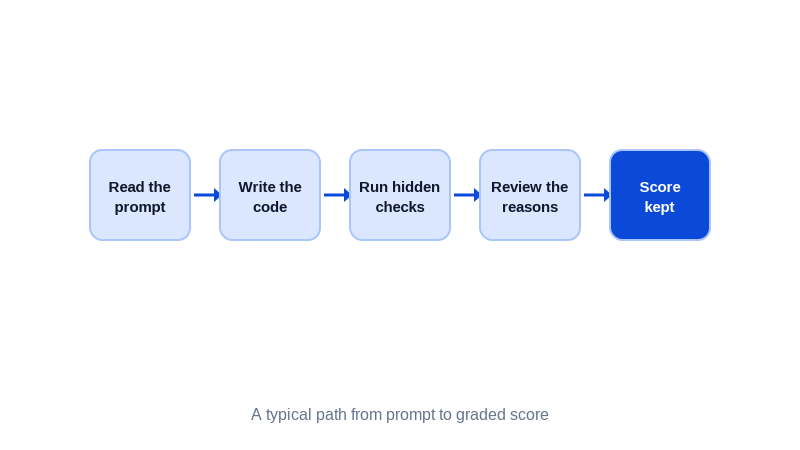
Hidden checks decide most of a code question
A coding question is often marked by a program. Your function runs against test inputs you cannot see, and the grader counts how many pass. The SWE-bench benchmark, a well-known public example, works this way: each task has Fail-to-Pass tests that fail before a fix and pass after it, and the page calls them the primary signal for evaluation. The benchmark has 2,294 task instances from 12 popular Python repositories.
Source: SWE-bench: original dataset page(opens in a new tab)
The lesson for a test taker is that the visible example is not the exam. If the example shows one input, the hidden set has a dozen more, including the awkward ones.
What the hidden set tends to contain
- The normal case from the example.
- Empty input, a single item and very large input.
- Duplicates, negative numbers, and values at the exact boundary.
- Input types or formats the prompt allowed but the example did not show.
- A time limit, in case your solution is correct but too slow.
Write it so the checks cannot surprise you
Before you submit, test your own code with inputs you invented. Here is a small example. The prompt says: return the index where a value should be inserted into a sorted list, placing it before any equal values.
from bisect import bisect_left def insert_position(sorted_items, value): return bisect_left(sorted_items, value) assert insert_position([1, 2, 2, 2, 3], 2) == 1 # before equal valuesassert insert_position([1, 2, 3], 5) == 3 # end of listassert insert_position([], 7) == 0 # empty listThe Python documentation says bisect_left returns an insertion point before any existing entries equal to the value, while bisect_right returns one after them. Picking the wrong one passes the simple example and fails the duplicate case. That is a typical hidden-check failure.
Source: Python docs: bisect(opens in a new tab)
Judgment questions are graded on reasons
Some questions show you code, or two answers, and ask what is wrong or which is better. A person or a rubric marks these. The marking usually looks at three things: did you reach the right conclusion, did you point at the specific defect, and is your explanation correct and clear.
| Weak reason | Strong reason |
|---|---|
| This code is bad. | The loop skips the last item because range stops at len(items) - 1. |
| Answer B is longer so it is better. | Answer B handles an empty list, which A crashes on. |
| Might have performance problems. | The nested loop is O(n squared); a set lookup makes it O(n). |
If you are not sure about something, say how you would find out. Honest uncertainty is better than a confident wrong claim.
What costs people marks
- Solving the example only.
- Changing the function name or signature the prompt specified.
- Printing instead of returning, or the other way round.
- Spending the whole time on a clever solution and submitting nothing that runs.
- Reasons that restate the code instead of judging it.
Rules around taking tests
Platforms that vet experts watch for cheating, because a score that does not reflect your own ability is worth nothing to anyone, including you. Use only the tools the test allows, work alone and expect checks on identity.
On Curatrain, tests are taken on camera. The checks for your face, phones and other people run on your own computer, anything that looks like cheating is saved as a still photo, and nothing is recorded as video or sound. You are told what is tracked before a test starts. Every score is kept, you see your score when you finish, and you get three attempts per test in any 90 days. No one fails on a single signal.
A way to practise
- Take ten easy problems from any public practice set.
- Write each solution, then write five tests including two hidden-style edge cases.
- Swap with a friend: each of you finds one bug in the other's code and writes the reason in one sentence.
- Time a full practice test so the real one feels familiar.
Sign up free at curatrain.com/login when you are ready to take graded skill tests.